Earwicker’s coffin
Finnegans WakeEarwicker’s coffin is at once a practical funeral object and an unstable image of death: it is mistaken for a musical instrument, assigned an elaborate public burial, and imagined as the beginning of another life beneath the ground. The passage makes the coffin’s solid presence a hinge between civic ceremony, commercial goods, burial, and renewed generation.
Appearance and Misrecognition
The coffin first appears as a triumph of illusion, naturally mistaken for a handharp. The prose makes the error part of a wider confusion among invented instruments and names, so that the object seems to resist a single, settled identity before it can be recognized as a coffin. Its visual ambiguity prepares for the passage’s persistent mixing of funeral seriousness with comic wordplay.
The coffin is later specified as teak, fitted with a glass panel, and oriented with its feet to the east. It is expected to arrive later and be placed near the porpoise; the narrative calls this placement materially consequential without resolving the phrase into a conventional explanation. These concrete details give the object weight and position even as its larger significance remains unstable.
Public Burial and Monument
A collection of conservative public bodies and committees arranges a temporary grave for Earwicker while his body still persists. They vote themselves, the town, port, and garrison out of existence, then present him with a grave in Moyelta, described as being of the best Lough Neagh pattern. The public act converts a private burial into a civic project, with committees and resolutions surrounding the body before it has ceased to live.
The grave is imagined as an underground heaven or mole’s paradise, a structure meant to encourage wheat crops and tourist trade. Its architect, Mgr Peurelachasse, is blinded lest he petrify the design, while contractors are made invulnerably venerable. The passage then turns the project into a fantastical military operation: a hydromine system blasts the structure, with an aerial torpedo, ammonia-filled tins, trip-up cables, and ground-battery fuseboxes. The coffin’s setting thus grows from a grave into an absurdly defended underground construction.
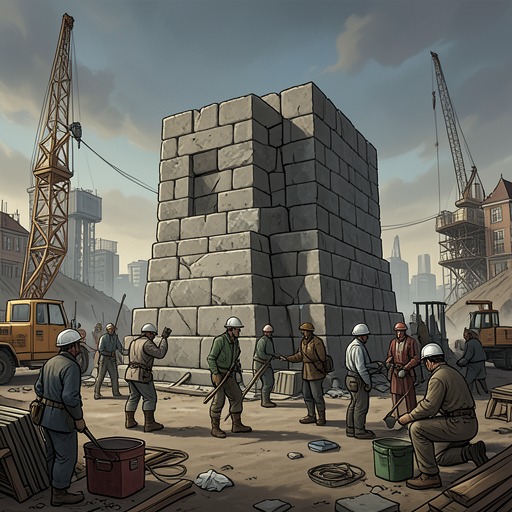
Afterward, the structure is carefully lined with ferroconcrete, rotproof bricks, and mortar. Earwicker retires beneath seven towerettes, whose names include the beauchamp, byward, bull, and lion, alongside the white, wardrobe, and bloodied towers. Public councils and guilds then present a stone slab bearing a Mac Pelah address and a ceremonious but false-meaning elegy. The coffin’s burial is therefore surrounded by civic pomp that the narrative both elaborates and undercuts.
Funeral Goods and Afterlife
The coffin belongs to a broad commercial inventory of death. Funeral premises supply it alongside winding sheets, biers, cinerary urns, vases, snuff chests, and other burial furnishings; the list expands into grotesque food and household objects, as if the whole material world could be recruited to adorn Earwicker’s tomb. The catalogue makes death not an escape from commerce but an occasion for its proliferation.
The passage imagines Earwicker embalmed, of great age and rich in anticipated death, lulled between explosion and re-explosion. Yet burial is not an ending: after the fall, the hidden figure rises again from the underworld, where he proliferates through successive layers and sends a new progeny of pots, pans, pokers, and puns back toward the upper world. The coffin’s deepest function is thus paradoxical: it encloses the dead, but the narrative makes burial a passage through which material and language return.